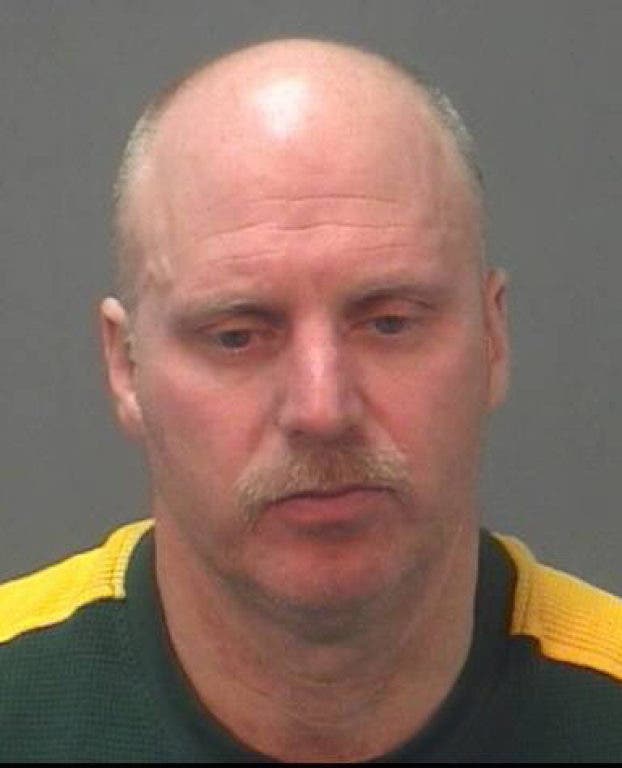
As Saukville police officer Jeffery Jiracek awaits a potential jury trial on a drunken driving charge, Police Chief Bill Meloy is conducting his own investigation to determine how to address a situation he said he can't remember ever before occuring in the department.
Driving off duty, Jiracek rolled his vehicle Jan. 15 in the town of Belgium. He was arrested by the Ozaukee County Sheriff's Department for first offense of operating while intoxicated. His blood-alcohol content was later found to be 0.18, more than twice the legal limit.
"I take this stuff serious," Meloy said. "Sometimes people put themselves above the law, and that should never be the case with law enforcement. We should be setting the example."
Jiracek, who is on a paid leave of absence, pleaded not guilty Feb. 2 in connection with the incident and hired an attorney. Because of the not-guilty plea, a jury trial was automatically scheduled and a jury status hearing is set for May 23.
On the night of his arrest, Jiracek had finished his shift at 6 p.m., Meloy said. He then went to a bar in Port Washington, where the bartender later told Meloy she served him four to five beers, and four to five mixed drinks, according to the Ozaukee County Sheriff's Department report.
Jiracek reportedly left the bar at about 9 p.m. to go to a bar in Belgium, according to the report, and was found about 20 minutes later next to his rolled-over SUV on County Highway LL.
From the track marks, police could see Jiracek had been traveling north when he crossed the oncoming lane and over the west shoulder into a field, hitting a ditch where he rolled over. Police reported strong odors of intoxicants on his breath, and arrested Jiracek for operating while intoxicated.
Depending on the outcome of Meloy's investigation, and Jiracek's legal proceedings, he could be suspended or discharged from the Saukville department. However, there's also the possibility he could resign before that happens.
The Saukville Village Board approved a resignation agreement March 13, the Ozaukee Press reported, after negotiations with the police union for an officer who has been on leave since January. The village won't say which officer the agreement involves until the officer decides to sign it.
"I have not seen a signed document," Meloy said. "I've been waiting to see it, but I haven't heard from anybody."
Jiracek hung up the phone when Patch called him for comment. Several calls to his attorney were not returned.
Even if Jiracek does not resign or get discharged, he could face other obstacles in continuing his police work. For a year following the offense, any OWI first-offender with a blood alcohol content greater than 0.15 can only drive vehicles equipped with an ignition interlock device.
Meloy said this would likely not be feasible for the department to accommodate.
"I would not allow it to occur," Meloy said. "He wouldn’t be able to drive our squad cars. Can you imagine how cumbersome that would be?"
Why aren't these 'reporters' checking this out? There are legal limits a bartender may serve and this was way over the limit.
by going to the bar to to try and hang the bar kept rather than suggest his employ own uptopersonal responsibility.
And C Schmidt, please give it another try. I have no idea what you were trying to say in your post. If you were trying to imply that his boss is trying to cover for him, I get no sense of that, at least in this article.
Walker had nothing to do with this. His bill addressed collective bargaining. It had nothing to do with civil service protections, which I believe remained intact. So it would be handled the same for a teacher, or any other public employee, as it has been for the last forty years. This has nothing to do with walkers bill, police unions, or any other factor other than a drunk cop doing something stupid and what the police chief is going to do about it.
A better question for me is did the sheriff's department and Saukville police show favoritism by not releasing this information in a more timely manner.
In my post I did not give an opinion as to the appropriateness of this process. What I did state is that your comments that police retained these rights while other public service employees lost them is incorrect. Wisconsin Act 10 only effected the ability of unions to collectively bargain, not their civil service protections. Those are still retained by all public employees, be they cops or teachers. In fact, there is language in the act directing governmental units to create a civil service process related to discipline to replace that which would have been in the contract. (Wisconsin Act 10, section 170) This civil service process is to include "(c) Any civil service system that is established under any provision of law, and any grievance procedure that is created under this subsection, shall contain at least all of the following provisions: 1. A grievance procedure that addresses employee terminations. 2. Employee discipline. 3. Workplace safety. Furthermore "(d) If a local governmental unit creates a grievance procedure under this subsection, the procedure shall contain at least all of the following elements: 1. A written document specifying the process that a grievant and an employer must follow. 2. A hearing before an impartial hearing officer. 3. An appeal process in which the highest level of appeal is the governing body of the local governmental unit.
"A local governmental unit, as defined in s. 66.0131 (1) (a), that does not have a civil service system on the effective date of this subsection .... [LRB inserts date], shall establish a grievance system not later than the first day of the 4th month beginning after the effective date of this subsection .... So, despite your claims to the contrary, the civil service protections for all public employees appear to remain intact. You still need to show cause to fire them, and you still need to follow the procedures of a process, progressive discipline, and appeals and review, be they teacher or cop. Now we could have a discussion about if those civil service protections should exist at all, but you comments and claims that Walker acted unfairly somehow by denying them to some public employees, and allowing them for others is just wrong.
What the hell are you posting? ACT 10 has nothing, NOTHING to do with cop unions or discipline! They are 100% exempt. Get that through your head. Post that section of the law. Get a copy of your local PD union contract and you will find these people are Teflon coated. Their contracts make the ACT 10 provisions look like it was written by sissies. Again, I ask, have you read your local PD contract? It is public record you know. If you lke what you find, hey, knock yourself out. But I do not think you will make that effort. And if you read any mainstream media, it is as plain as your nose that Walker approved the exemption. Do the words fairness, reason and fiscal conservatism make one "left" as you elude to? Do you think a cop arresting you for DWI that has one on their record is acceptable? I
My problem with your post is that you clearly and Incorrectly stated that this was Walkers fault for removing these protections from public employees and leaving them for the cops. That is an incorrect statement. Act 10 left these civil service protections in place for ALL public employees. It didn't address it, and wasn't intended to. Accuracy matters.. Your post wasn't. I am merely pointing that out. Own it, its yours.
To follow your reasoning, then why do we need to pass laws to get rid of one union because they protect the less than brightest teachers, but continue to allow unions to protect the less than brightest police? Do you see the conundrum in your reasoning? What are you “backing”? For the record, Einstein and MT had nothing to do with public education and policing.
In all civility, get a copy of your local PD union contract and read it. It has the force of law (no pun intended) word for word w/o interference from ACT 10. ACT 10 is meaningless to them. Call your city or village administrator and ask them if you don’t believe me.
You still aren't reading my posts, or at least not understanding them. I've never claimed differently. In fact it is what I have been saying. "Act 10 left these civil service protections in place for ALL public employees. It didn't address it, and wasn't intended to." Now to review "Yet the rabid union haters think the badges deserve an ACT 10 pass." "Are you postulating that it is okay for cops to retain these rights but not teachers and other public sector unions?" You seem to think that the cops got a pass that the other public employees didn't. Not true. All public employees still retain civil service protections, not just cops. Act 10 is clear on this as I outlined above. "That was one of the main reasons why ACT 10 was enacted." actually again, if you read the act, sections of which I outlined above, it was not intended to address these issues, only unions and collective bargaining. You seem under the mistaken impression that it is the unions and union contracts that prevent governmental units from just firing him without process. While union contracts do include that language, it just mirrors state law that grants these protections to all civil service employees. If this were the police chief for example, the village would still have to follow the same process. He isn't in a union, but state law still grants him the same protections.
So his penalties for this offense will be more severe than those of the average citizen. Note, I am not sympathetic, he did this to himself and he deserves what he gets.
You don’t strike me as an individual who gives a tinkers damn about civility anyway so get off your internet high horse. Shouting me down with repeated assertions that ACT 10 provisions apply across the board with all unions isn't working. Where do you get your info anyway? On the internet? Talk radio? Or in real life work? Have you read a cop union contract which I have asked twice now? Answer this yes or no truthfully. What makes you judge and jury to make statements that this cop will lose his job? Did you not read the original posting I made about Milwaukee cops keeping their jobs despite DWI convictions? More homework for you.
Let's just agree to disagree and end this discussion. Either of us is going nowhere with this. OK?
Disagree if you will, but when it comes to discipline and termination issues it does cut across the board for all public employees. And as to where I get the info, its from the actual document itself; Wisconsin Act 10, Section 170, and state statute 66.0509 (1m). Please feel free to read both, as I have. A simple google search will provide you with both documents. "Have you read a cop union contract which I have asked twice now?" Yes, in fact I have several, from several agencies. And they allow for a grievance procedure that addresses employee discipline which includes a written process, a hearing before an impartial examiner and a appeal process. These also are the things specifically allowed to all civil servants by the act and statue I cited above. Which is what I have been saying the whole time. Feel free to look it up. "What makes you judge and jury to make statements that this cop will lose his job?" Don't need to be judge or jury. It's too small a town and people talk. He has actually already resigned. It just has not caught up to the press yet.
In all honesty, I fully expected this to be a "agree to disagree" discussion after your second post, but I do want to make sure that no one else is getting drawn in by the incorrect assertions that have been made.